
Not a Setback
on finding queer agency in traditional spaces

It should come as no surprise, but I’ve been thinking about gender quite a lot lately. I’ve especially been mulling over the role of gender in the institutional church as well as the nuclear family unit. While I am far from a traditional person myself, I exist within both of these very traditional structures. There are a number of ways I deviate from the norm of the nuclear family and the historical expression of a clergyperson in the institutional church.
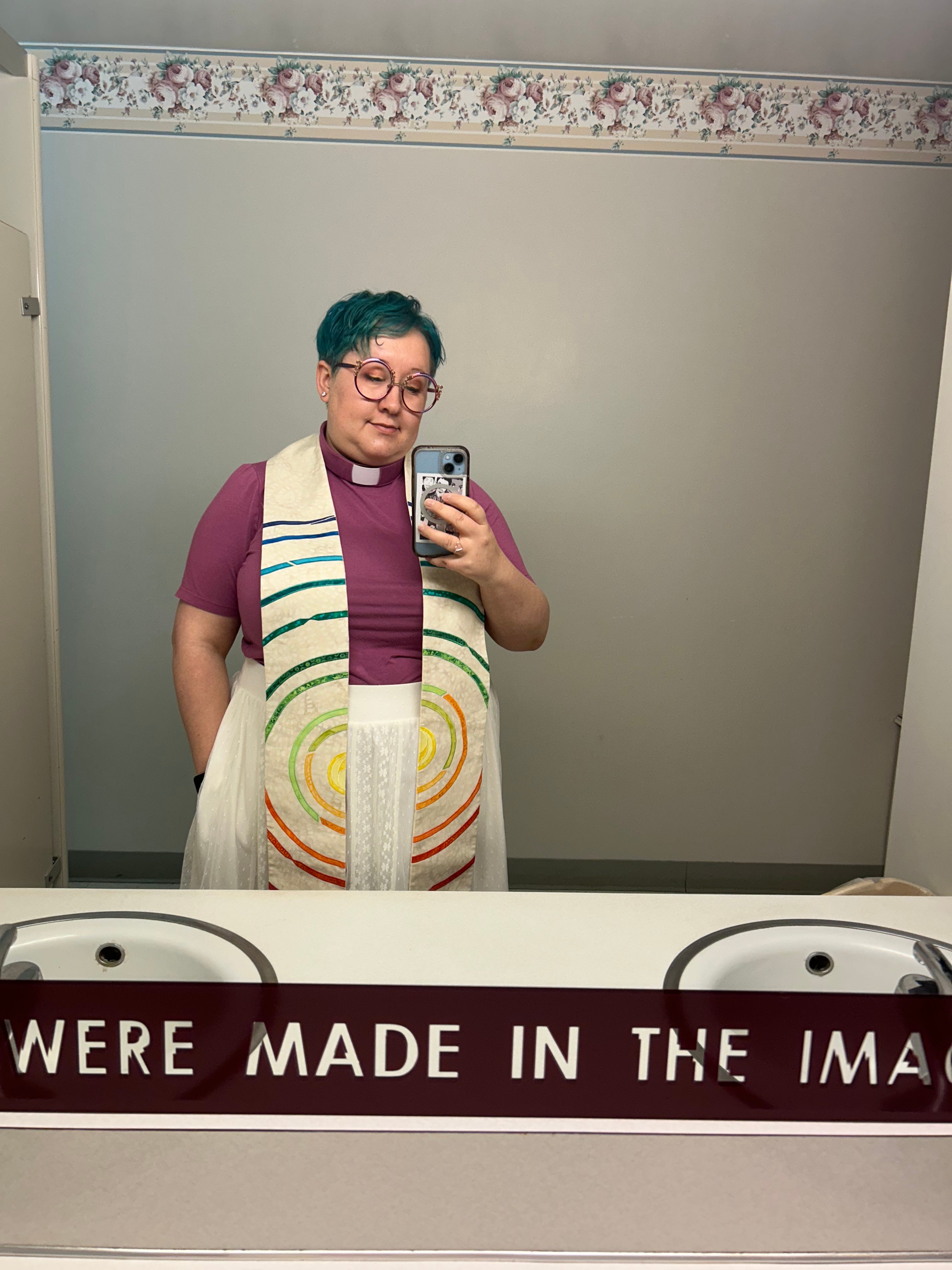
When it comes to gender, the way I think I would explain my experience of coming out as non-binary is that I was cisgender until suddenly I was not. Or rather, by no intention of my own, I must have been shoveling away at the dirt of traditional institutions, and suddenly I hit gender nonconformity like bedrock and all hell broke loose. The shovel disintegrated along with all my certainty about who I am, and a thing I had long been sure of suddenly became an untruth.
I don’t talk about it that much anymore, at least not publicly, but I was raised in a cult, not for my church upbringing (thank goodness), but in my education experience. I attended The Oaks Classical Christian Academy, an ACCS-accredited school, rubber stamped by Trump’s good buddy and prominent Christian nationalist Douglas Wilson. I try not to harp on it too much around my family (sorry, mom and dad), because I’m sure sending us there was a sacrifice in many ways, and the idea that I Went to Private School and All I Got Was Religious Trauma™ is an unfortunate one. I wrote about my experience in The Oaks Alumni Letters, so this is not the first time I’ve spoken about it.
I could talk about The Oaks at length, and in fact I did recently with a journalist from the Wall Street Journal (no idea what will come of that), but the thing I will focus on is my experience of my call to ministry. I truly believe I owe my early sense of call to The Oaks. The extensive and intensive exposure to scripture, the integration of religion and theology (if you can call it that, lol) into my academic life during formative years is without a doubt one of the reasons I felt called to ministry at eight years old. I think I would have found my call anyway, but I don’t think I would have found it quite so early. As you could imagine, in a place with what I have described as “archaic, outdated, draconian gender roles,” the fact that I heard the whisper of the Holy Spirit at age eight telling me I was to learn how to speak behind a pulpit was a bit, um, taboo.
Ultimately, I chose to remove myself from The Oaks, the community I had known and loved and cherished for my entire memory, because my sense of call to ministry was clearly not to be tolerated. While I don’t recommend switching from private school to the biggest public high school in your city as a sophomore (what even is a locker? Did I have one? Who knows? Not me.), I nevertheless found agency in the decision.
All of this is to say, I had to fight for my identity as a woman for as long as I can remember. My gender has always been something I have had to defend. In some ways, this makes my experience of gender nonconformity make a lot more sense, but in others, it makes it incredibly confusing.
Something that has become abundantly clear to me is that in my ministry setting, my preferred pronouns will never be fully adopted. I am not surprised by this at all. It’s why I took so long to switch to they/them.
Somehow, when I did switch almost a year ago, I think I was aspirational and optimistic, things I am always afraid to be and most often avoid at all costs. And it’s disappointing, yes, that my hopes have gone unrealized, but it’s not surprising. It’s even understandable, given the culture the church finds itself situated in.
I don’t actually know anyone who has done this (I’m sure I’m not the first), but I am adding she/her back to the pronouns that can be used for me.
I’m working this out as I write these words, so my thoughts are far from organized, but I think what I’m trying to say is that the sense of agency that I had when I chose to leave The Oaks is something I need in this moment. Maybe it will change. But choosing to allow she/her to be an option that I consent to feels a lot more like agency than being misgendered constantly. Who knows? Maybe it will still feel like misgendering. But I have been fighting for so long, and I am tired of fighting. I would like some ease, and I know if I stick to they/them there will be no ease, if purely because of my context.
I know so many of us deal with misgendering. The church is not unique in its commitment to traditional gender structures, even on the progressive side. We still have “women’s” retreats that don’t have expansive language. I don’t think I’m resentful about this. I think I’m moving from optimism to realism and also acknowledging what stress I can and can’t tolerate. And at least right now, I don’t think I can tolerate the fighting. I’ve been fighting since I was eight years old, and I’d like to know ease for once.
For me this is what feels like agency at this time. I don’t think this is the right choice for everyone. But it’s what I need to do for now.
Shout out to my style coach, Tess Clabby, for helping me find a gender expression that makes me feel non-binary no matter what people call me or how I’m referred to. It turns out that gender presentation/expression is just as (or more!) important than pronouns, at least for me.
I still prefer they/them. But I have arrived at a point where I can say she/her isn’t misgendering, if only because I need it to not be. I’m not a woman, but I’ll attend the women’s groups and lead workshops at the women’s retreats and it will feel a little better, I hope.
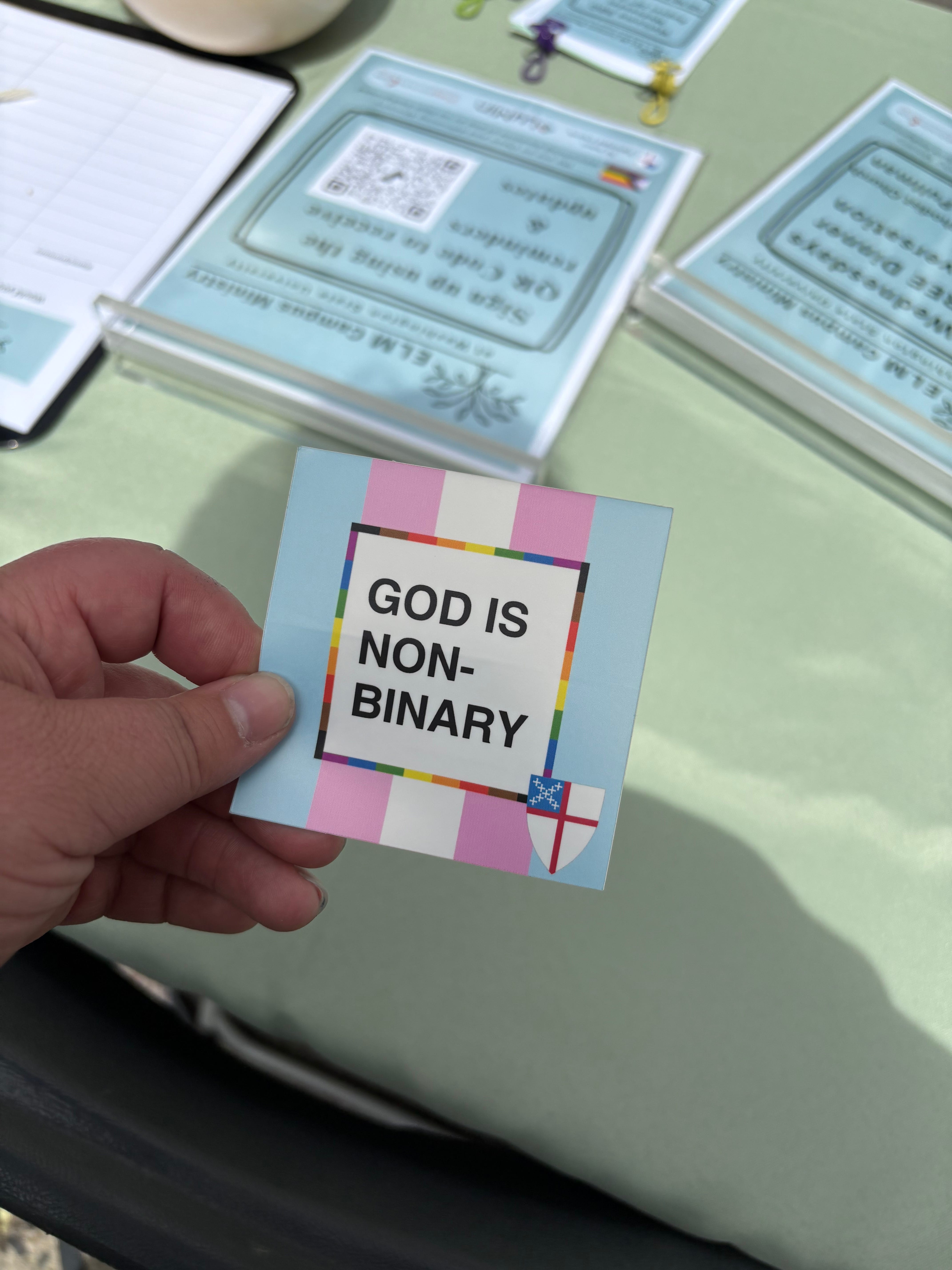
I like to think there is no perfection when it comes to queerness. That we’re all still sort of stumbling around in the darkness, fumbling our way out of the closet over and over again. I think the last year was an experiment, and I don’t think it was a failed experiment. I think I learned a lot. I don’t feel less me because of this decision. And maybe it’s lower stakes than I’m making it. But that’s the whole point, honestly. To make everything feel a little lower stakes.
So here’s to ease. Here’s to compromises and the things we do to find respite. Here’s to realizing we can be ourselves no matter what.
-d (they/she)
It feels like most days are a battlefield until I choose to do sabbath rest from it all. Then I pick up the gauntlet again. Equality in gender, gun control, and equal rights for the earth are things that bring tears of suffering now. Peace be with you my friend.
"I’d like to know ease for once" -- this is going to stick with me